A Growing Coalition is Fighting Censorship in California’s Public Schools
Critics warn that Assembly Bill 715 only emboldens right-wing groups and their attacks on students and teachers.

Paid subscribers make my reporting possible. Consider joining them:
A bill signed into law this year in California under the guise of curbing antisemitism brings President Donald Trump’s attacks on education to the state’s public schools. Assembly Bill (AB) 715 expands the state’s authority to ban instructional material in K-12 schools based on ill-defined standards.
It has been widely reported that the bill passed without opposition, as lawmakers who spoke out against it abstained rather than voted no when it came time to do so. But that narrative could not be further from the truth: A diverse coalition of over 100 civil rights and racial justice organizations, religious congregations, and groups of parents, educators, and students mobilized against AB 715 — and shows no signs of stopping now that it has passed.
“We are committed to continuing to fight AB 715 in its implementation and do whatever we can to roll back the harms that we believe were intended by this bill from the beginning,” said Lara Kiswani, executive director of AROC Action and an organizer with the California Coalition to Defend Public Education (CCDPE). The coalition includes California's largest and most powerful unions of teachers and faculty, as well as the Coalition for Liberated Ethnic Studies, American Civil Liberties Union California Action, and local branches of Jewish Voice for Peace (JVP) from across the state.
The coalition came together against AB 715 earlier this year, arguing that the legislation threatens to chill free speech and censor teaching and classroom discussion on the topic of Palestine. The bill is the latest in a years-long series introduced by members of California’s Legislative Jewish Caucus, a pro-Israel group of lawmakers, claiming to address antisemitism in public schools. The proposed bills have been criticized for their potential to censor classroom material and discussions and disrupt the implementation of earlier legislation mandating ethnic studies courses in California’s public schools. Earlier efforts were met with strong opposition from many of the same educators and rights groups and failed to advance.
This year, AB 715 seemed to be heading in that same direction as CCDPE grew and its members requested meetings with lawmakers and spoke against the bill at public hearings alongside other concerned members of the public. But in a process that coalition members characterize as undemocratic, the bill was “rammed through with no space for feedback from community or labor partners [and] stakeholders,” said Kiswani.
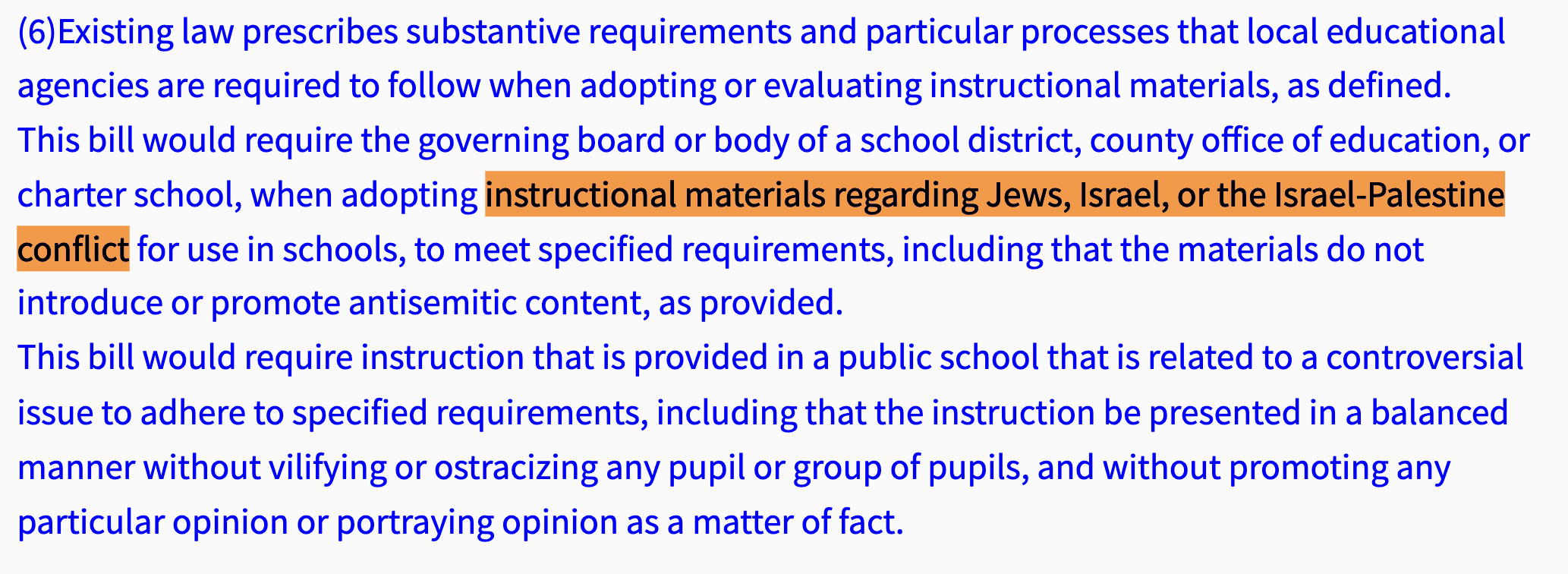
Rather than meeting with stakeholders, LJC members and co-authors Rick Chavez Zbur and Dawn Addis met in private with other lawmakers to negotiate amendments. Most notably, the authors struck any mention of Palestine or Israel, although early versions of the bill explicitly targeted “instructional materials regarding Jews, Israel, or the Israel-Palestine conflict.”
To respond to criticisms that AB 715 exceptionalizes Jewish safety over the safety of other marginalized groups by creating a governor-appointed discrimination prevention coordinator role focused only on antisemitism, AB 715’s authors also agreed to back Senate Bill 48. That bill creates four additional discrimination prevention coordinator positions for cases of discrimination based on religion, race or ethnicity, gender, and LGBTQ status, respectively.
Still, until the legislative session closed on September 12, opposition groups and lawmakers continued to express concern about the last-minute, closed-door nature of amendment talks and the bill itself. Mia Bonta, a member of the Assembly Education Committee, said in a September 11 committee hearing that she had been “robbed” of her right to vote on the legislation after a half-formed version of the bill was allowed to pass out of committee in May and an anticipated second vote was not allowed in September owing to the time crunch and inflexible procedural rules. During that same hearing, Committee Chair Al Muratsuchi characterized the bill as one that would “attack education [and] suppress critical thinking [and] open discussion in our classrooms.”
The following day, on the floor, Assemblymember Robert Garcia argued that the bill “reinforces broader national trends of silencing constitutionally protected speech, erasing historically relevant curriculum, and persecuting anyone who expresses even the slightest opposition to the federal administration.”
Despite their condemnations of AB 715, Muratsuchi and Garcia abstained rather than vote against it — a common tactic of California Democrats who hold a supermajority in the state legislature, meaning most votes involve bills from their political colleagues whom they prefer not to be seen voting against. Seven other Democratic lawmakers also abstained. Gov. Gavin Newsom signed AB 715 into law in October.
Even before AB 715 passed, pro-Israel and other MAGA-aligned groups had been pressuring school administrators and educators to conform to their right-wing agenda. “We’ve been seeing teachers being pulled aside, penalized, [and] targeted for wearing a watermelon button or a keffiyeh or creating space for students to talk about the genocide in Gaza, creating space for Arab, Muslim, Palestinian, Jewish students to speak out for human rights, and we’ve been seeing student groups being penalized and discriminated against,” said Kiswani.
Almost as soon as California passed an ethnic studies graduation requirement for high school students in 2021, right-wing groups were spurring harassment campaigns against teachers involved in its implementation and fighting against it in court. The Deborah Project, a pro-Israel firm, filed a lawsuit in 2022 on behalf of teachers and parents who accused educators named in the suit of using antisemitic content in their classrooms. The case was later dismissed.
The following year, the same firm sued the Mountain View–Los Altos High School District and the Hayward Unified School District for the release of records related to ethnic studies classes; both districts settled and agreed to cover the legal fees. This February, a suit brought by the Louis D. Brandeis Center, another pro-Israel group, succeeded in stopping ethnic studies classes in the Santa Ana Unified School District.
“It’s not like this is new, but with AB 715, it will ramp up and give Zionists more ammunition,” said Seth Morrison, a spokesperson for JVP’s Bay Area chapter and an organizer with CCDPE.
Meanwhile, groups opposed to AB 715 are continuing their efforts. In November, the American-Arab Anti-Discrimination Committee (ADC) filed a suit challenging the law in federal court. It also filed a motion for a preliminary injunction, which would prevent the law from taking effect while the case progresses.
The suit challenges the law on the grounds that it is unconstitutionally vague, constitutes viewpoint discrimination, and will infringe students’ First Amendment right to receive information in the classroom. “It’s a stunningly poorly written law,” said Jenin Younes, ADC’s national legal director, pointing, among other things, to the fact that the law does not define antisemitic discrimination, opening the door to arbitrary and uneven enforcement.
While AB 715 does not define antisemitism, it calls for using the Biden-era United States National Strategy to Counter Antisemitism to inform decision-making. That white paper, in turn, claims that the nation “has embraced” the International Holocaust Remembrance Alliance (IHRA) definition of antisemitism, which conflates criticism of Israel with antisemitism. Other aspects of AB 715 encourage that same dangerous conflation. Rights groups, including JVP and Human Rights Watch, have warned that the IHRA definition chills and suppresses First Amendment-protected political speech.
“The most glaring problem with the law is that it’s not clear about what it’s prohibiting. But then it seems to, it definitely gives people the impression that it's prohibiting First Amendment-protected speech,” said Younes.
While the lawsuit moves through the courts, others are strategizing how to amend the law to reduce harm if it’s still standing during the next legislative session. Theresa Montaño, a former public school teacher who now teaches Chicano/a Studies at California State University, Los Angeles, and is a member of the California Faculty Association, said that thanks to rank-and-file organizing, union leadership is committed to pushing the legislature to “move on the most troublesome parts” of AB 715.
That includes striking any reference to the IHRA definition of antisemitism and language that requires classroom instruction to be “factually accurate.” While that may seem reasonable at first glance, requiring “factually accurate” instruction while punishing teachers for statements about Palestine rooted in primary source research, for example, the fact that the creation of the state of Israel entailed the ethnic cleansing of at least 750,000 Palestinians, places educators in an impossible position.
Sources I spoke to also want to see changes to the new anti-discrimination coordinator roles. “We don't want to see five coordinators. We would rather streamline it into a single role of civil rights coordinators, who cover all issues,” said Montaño. If coordinators worked across cases of discrimination, rather than one coordinator each for discrimination against Jewish students and four other groups, Montaño said, it would “allow for a more intersectional approach, a more realistic approach, and even a more collaborative approach” to stamping out discrimination in California schools.
Organizers hope that the struggle around AB 715 will continue in a more democratic way than the last-minute backroom deals that got it through the legislature. For members of CCDPE, the way forward must be more transparent, representative, and in the spirit of the broader coalition.
“We are a community, and as a community, we should be very, very concerned …that educators are losing the right to teach truth,” said Montaño. “That’s what’s at stake here — whose truth, whose history, whose education system.”
 Marianne Dhenin
 Marianne Dhenin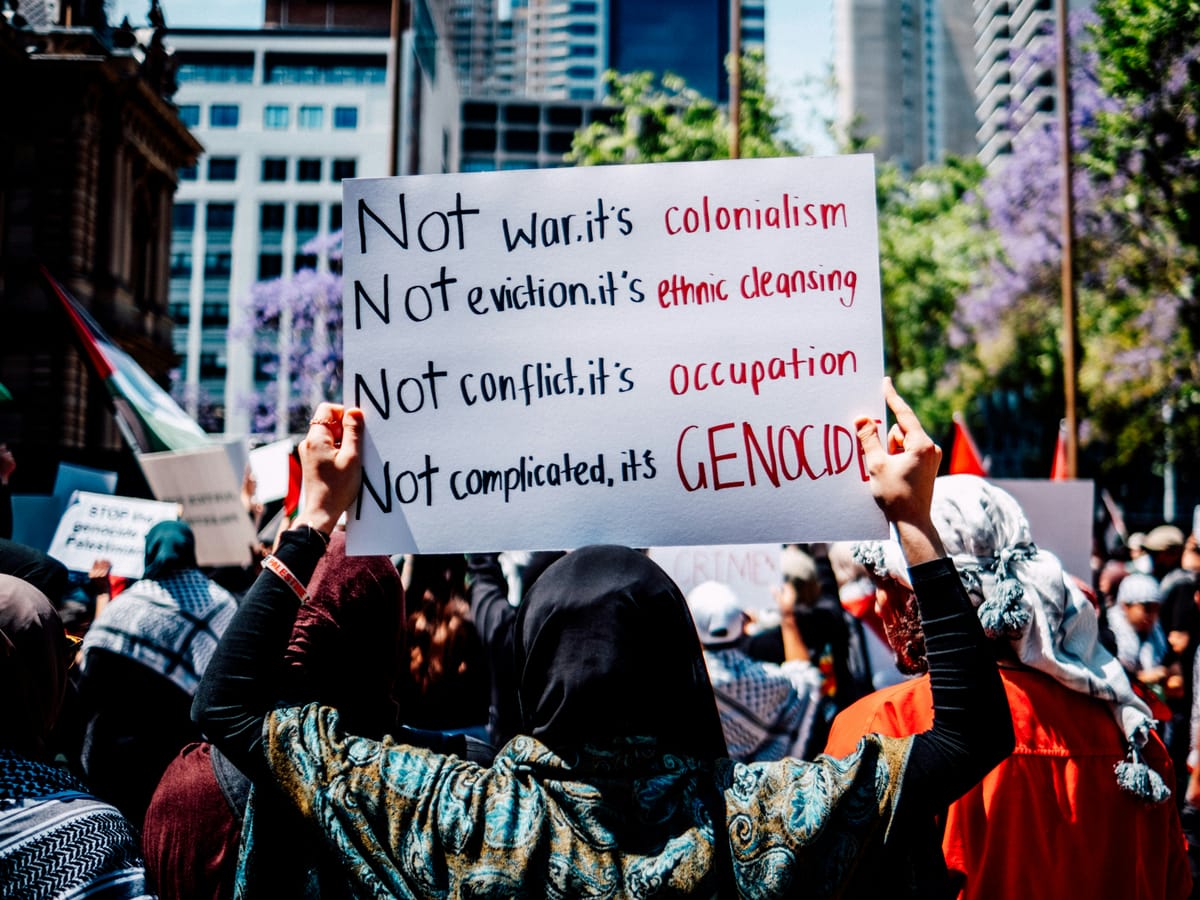
If you'd like to republish this story, send me an email.