
To get half off an Eco Files subscription, click here.
To get half off a subscription to this newsletter, click here.
Climate change is a growing threat to Palestine, as the nation faces a staggering projected decrease in precipitation, a significant bump in average temperatures, and dangerous sea-level rise along its Mediterranean coastline. The Israeli occupation has long prevented Palestinians from accessing resources and pursuing measures needed to support climate change adaptation.
The situation is even more dire in Gaza after over two years of Israeli bombardment and scorched-earth tactics that have damaged the enclave’s natural environment on an unfathomable scale. At least 97 percent of its trees, 95 percent of its shrubland, and 82 percent of its annual crops have been destroyed, according to the United Nations. The destruction of Gaza’s sewage and water networks has poisoned the strip’s groundwater. Last November, an international people’s tribunal convened by civil society groups in Barcelona, Spain, recognized these harms when it charged Israel and Western governments with the crime of ecocide.
Now, many of those same governments, including those of Israel and the United States, have tasked themselves with reconstructing Gaza and leading an international policing force in the territory. Legal experts and rights groups have condemned the plan, arguing that it violates Palestine’s right to self-determination and will fail to protect Palestinians.
When I traveled to Barcelona to cover the people’s tribunal, I spoke to Mohammed Usrof, the founder and executive director of the Palestinian Institute for Climate Strategy. Usrof is from Gaza, and his family was forced to flee from Khan Yunis when Israel besieged the city beginning in December 2023. When we spoke during the people’s tribunal, Usrof told me that recognizing environmental harm as a form of criminal violence “could be transformational” in the climate struggle.
Recently, I caught up with Usrof again to learn more about the ongoing climate crisis in Palestine, its ties to the genocide being committed there, and the paradigm shift needed to achieve both climate justice and Palestinian liberation.
Editor’s note: These responses have been condensed and edited for clarity.
Marianne Dhenin: How do you understand the genocide in Palestine as related to the environment or to climate change?
Mohammed Usrof: The genocide is not just a genocide, and it’s not just a humanitarian issue. It’s the culmination of a systemic extraction of resources and logistical networks that have fueled this occupation for hundreds of years, whether that’s the fossil fuels that have powered the Israeli economy and its weaponry or the pipelines — it’s all structurally embedded.
There’s a complete dehumanization of the people, of Palestinians, but also a separation between the people and the land. The longer we do this detethering and separation, the longer we ignore the material aspects of wars and genocides; they’re bound to happen anyway because they’re printed in the infrastructure.
The paradigm that’s being taken up now tries to separate climate from the political and say, “Look, we can plan for climate resiliency, we can address climate change without the political, the material conditions that these people are facing.”
But the approach we should take when looking at climate change and taking action against the genocide is to focus on the people themselves.
MD: You mean, we shouldn’t be separating people from land, and by addressing people’s material needs, there’s also some acknowledgment that we have to better their climate? Could you elaborate on why this is particularly important in the case of Palestine?
MU: Yes, one crucial thing to keep in mind is that the Palestinian people are Palestinian people because of the land that they’ve lived in. There is this narrative that the Palestinian people are steadfast and have an ecological belonging to the land. But it’s not only that. The crucial thing about the Palestinian identity over the past hundred years is this wanting to live in dignity and not be spread all across the world, not be in refugee camps in Jordan and Syria, not be without a passport in Egypt or other countries. The whole Palestinian movement is one of wanting to live with dignity and live back on the land.
The Palestinians are also very agrarian people, and have always relied on farming for as long as the people have been there. The destruction of all the hectares that would have been available for cultivation has a deep impact on how Palestinians live their lives. Even my own family’s olive groves have been completely erased, and it’s much more than just land. It’s much more than crop production and a capitalist way of seeing it. Agriculture is how people express their attachment to the land and how they work and live with dignity.
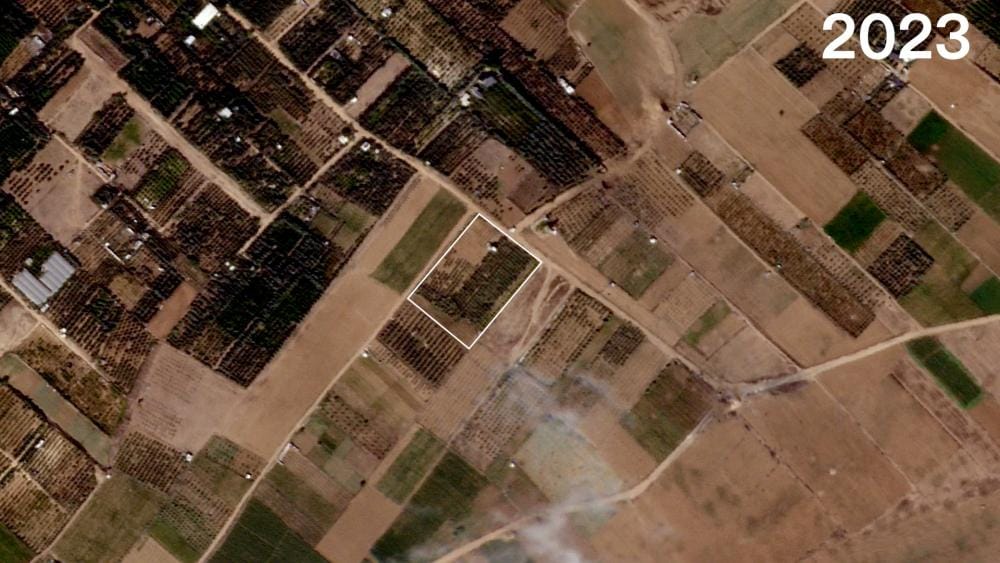
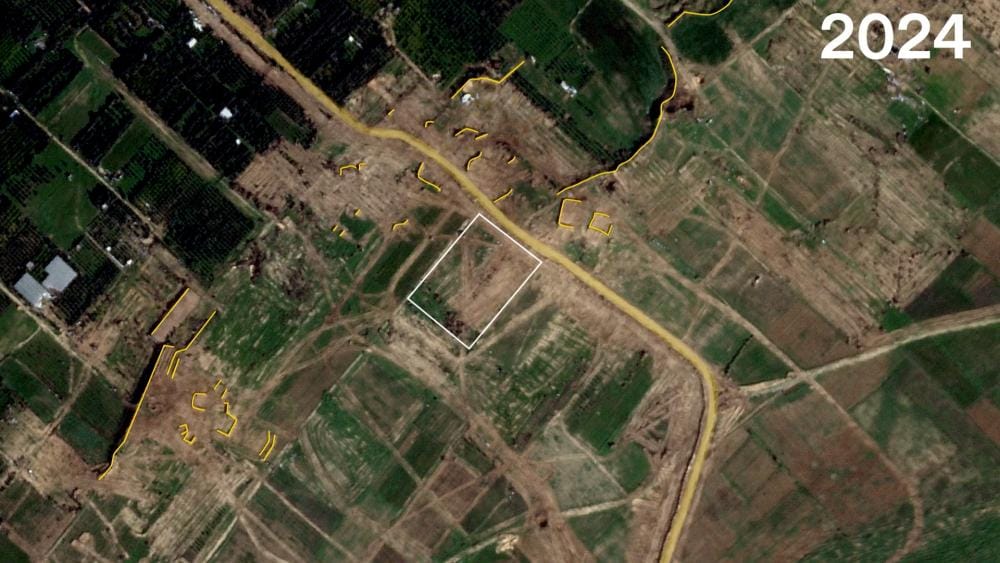
The Abu Suffiyeh family's farm in Gaza, before and after an Israeli attack. The yellow lines on the right-hand image mark new military infrastructure. Photos from Google Earth; analysis and overlay from Forensic Architecture.
MD: The destruction in Gaza is unprecedented. What do you see as Gaza’s future given the current circumstances?
MU: As a Gazan myself, I think we’re in a moment where we’re realizing that there’s no Gaza to go back to and no reconstruction plan can ever bring it back because the land and the soil and really every part of what I knew of Gaza has been completely erased. It’s not just a genocide or an ecocide, it’s a complete erasing of the memory of the Palestinian people and of their land.
It’s also sad to see reconstruction being treated like more of a burden than a responsibility. It’s sad to see that the segregation, physical segregation between the West Bank and Gaza, can be so evident in these development plans. There’s a lot of complicity within the state of Palestine and within other states when we take the issues of humanitarian assistance, development, diplomatic solutions, and even climate change solutions at face value instead of thinking about them critically, because doing that completely erases the structural injustice that we see here.
Now, in such a so-called transition moment, quote-unquote “post-genocide,” with the current ceasefire plan, what’s needed is shifting from this control-based system under the Israeli government to a people-centered system. The current plans are overly bureaucratic and disconnected from our Palestinian society or community and disconnected from our basic human needs.
MD: What’s the significance of calling out those structural issues in climate work, and how does your knowledge and lived experience of Palestine inform that work?
MU: It’s critical to politicize climate change and not treat it like a natural disaster. It’s crucial to remember that within the context of climate change in Palestine, as an example, there’s a hundred-year history of infrastructure being put in place that led to the current war economy and that led to the current power that the Israeli government has. Palestinians are in the situation that they’re in because of a political economy embedded in pipelines filled with blood over hundreds of years, built by the British mandate, and the Anglo-Iranian company, and the Seven Sisters in the mid-1900s. There is also a lot of corporate complicity and embeddedness across global industries, trade, and fossil fuels that contribute to the issue.
But mainstream media and mainstream climate work ignore those structural and root issues. The longer we ignore them, the more it’s going to enable genocide. We pretend “Oh no, it’s because we don’t have the right humanitarian solution.” But no, it’s just not going to work.
It’s the same thing with climate change. The longer we ignore the fossil fuel economy we live in and the manifestation of fossil fuel cultures in our day-to-day lives, we’re just not going to be able to actually tackle climate change because we’re so embedded in it. No form of green transition will help us get out of it without structural change.
So I think that’s why climate and Palestine really go hand in hand, because it’s about time that we imagine and build this vision for a proper transition away from what are evil roots and roots of corruption.


